
Somebody Has to Ask It: Are We Finally Ready to Protect Black Leadership?
There is no mystery in what is happening.
No confusion. No need for handwringing analysis. No reason to stand around asking, “How did we get here?
” We know exactly how we got here.
This is what happens when people fail to defend their own power.
This is what happens when attacks on Black leadership are treated like somebody else’s problem. This is what happens when we allow division, petty politics, personal grudges, and selective outrage to weaken the very institutions, offices, and leaders that generations fought, bled, organized, and voted to build.
And now look.
The people of New Orleans overwhelmingly elected Calvin Duncan as Orleans Parish Civil District Court Clerk of Criminal Court. Sixty-eight percent of voters said, clearly and decisively, this is who we choose. — a man wrongfully imprisoned for decades, a man who came out of injustice committed to reforming the very system that failed him.
And what happened?
Before he could even take his seat, an overreaching governor and legislature erased the position. Eliminated it. Not after he served. Not after failure. Not after scandal. Before he could even begin.
While that move has been temporarily halted by a federal judge’s ruling, paving the way for Duncan to assume office, we don’t expect Landry and the rest of the state’s MAGA Republicans to go quietly. And whether they ultimately succeed is not the real issue. The fact that they even tried it is a gross exhibition of contempt for the vote of the people.
Meanwhile, Gov. Jeff Landry has suspended Louisiana’s congressional elections — halting an election already underway, changing the rules midstream, freezing representation by executive order while ballots are already in voters’ hands. Contrary to what he says, there is no state of emergency.
The message, again, is unmistakable: Your vote counts until it becomes inconvenient.
Even more diabolical is that Landry has sent a not-so-subtle message that he is willing to interfere with future elections. Let’s not pretend that Trump supporters and political allies have not openly advocated for ways for Trump to stay in power beyond a second term as it is clear that the Constitution means nothing to these people.
Y’all still think this is random? Y’all still think this is politics as usual?
The state is steadily reaching deeper into the affairs of New Orleans, stripping authority from local voices, overriding the will of the people, and reshaping governance in ways that make local self-determination feel increasingly conditional. Officials are publicly humiliated, criminalized, and dragged into spectacle. Black leadership finds itself under relentless scrutiny, indictment, investigation, and attack, often with a level of vigor conspicuously absent in other quarters.
And too many among us are standing on the sidelines, watching it unfold like it has nothing to do with them. Until it does.
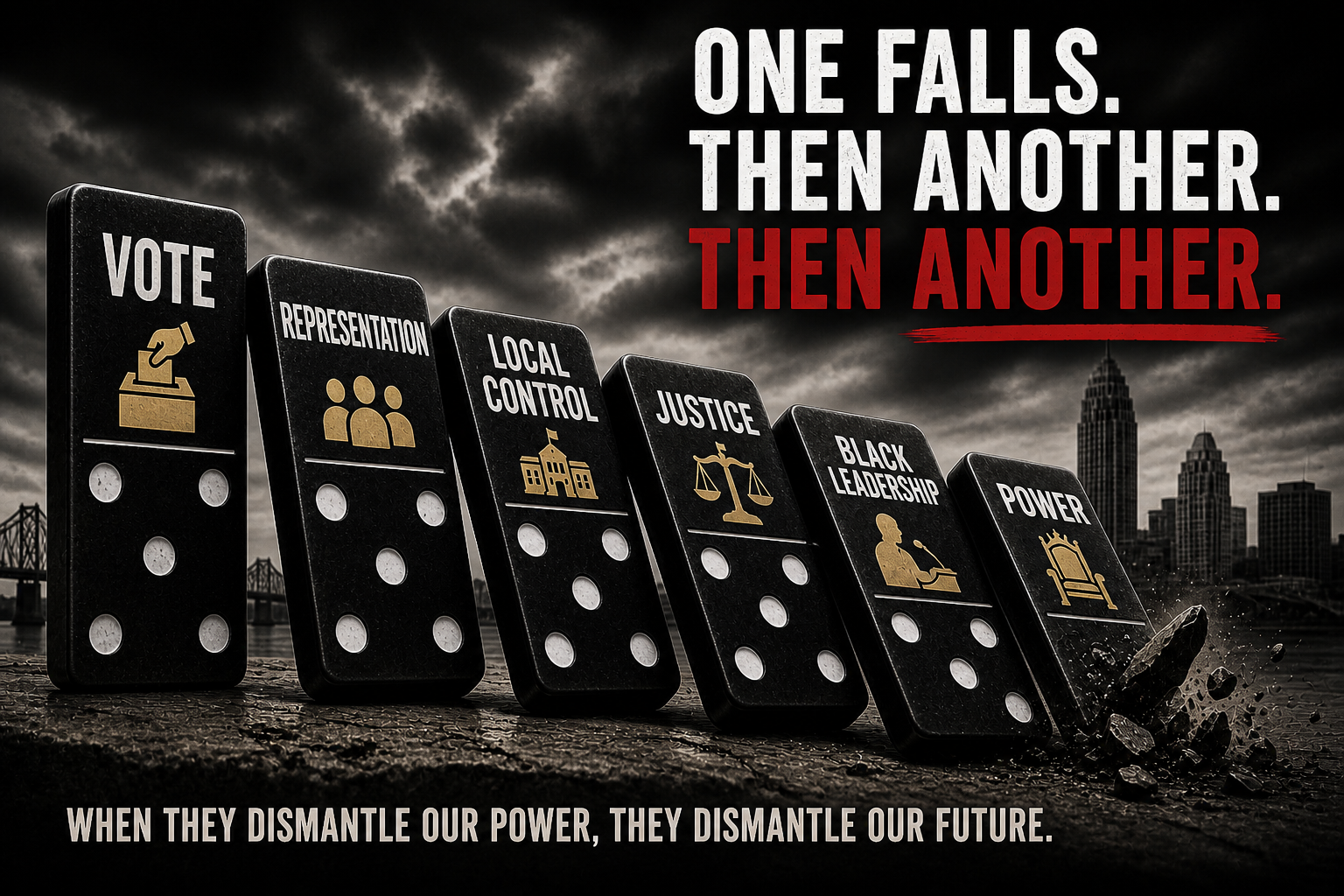
That is the lesson too many fail to understand: if they can do it to one, they can do it to all. If they can diminish one office, they can diminish another. If they can nullify one election, disregard one constituency, or politically bury one leader, they can do the same to anyone whose power depends on the voice and votes of Black people.
And eventually, it will be you.
The seat you thought was secure. The office you thought was untouchable. The neighborhood you thought was insulated. The vote you thought would always matter.
It will be you.
What we are witnessing is why Black communities have always needed a united front — not blind loyalty, not uncritical support — but a clear understanding that political power, once fractured, becomes easy to dismantle. We have said this repeatedly, we will say it again: Protecting Black leadership has never been about protecting personalities. It is about protecting influence, representation, leverage, and community self-determination. Because if we don’t protect our own political infrastructure, no one else will.
We have been here before in American history. Power is rarely taken all at once. It is chipped away—piece by piece, office by office, leader by leader—while people convince themselves each attack is isolated, each indictment is unique, each power grab is justified, until the pattern is undeniable. By then, the damage is done. We are watching it happen in real time.
Somebody has to say it: this is what happens when you let them run roughshod over Black leadership without consequence, without resistance, and without unity — not because they were stronger. But because we were divided. Too many of us keep responding to calculated strategy with naïveté, at best, while others go along to protect their own temporary, self-serving comfort, at worst. And while some are still playing patty-cake, forces much larger than personality, party, or one election cycle are moving deliberately to weaken the collective power of our communities.
We keep hearing, “This isn’t about Black and white.” Meanwhile, America keeps proving otherwise — not always with words — but in outcomes, in priorities, in enforcement, in who gets protected, in who gets prosecuted, in whose power is respected, and whose power is treated as negotiable.
That is why the Black community must stop being fragmented, politically careless, and easily divided. That is why we keep screaming loudly and often “PROTECT BLACK LEADERSHIP!”
That is why we must build coalitions that to defend the community’s voice and power with a clear understanding that if one segment’s power is stripped today, another’s power will be stripped tomorrow.
We knew where this road would lead. Now that we are here, we will not act as if what is happening is accidental or incidental. This is deliberate. And if we do not begin moving with equal deliberateness, equal discipline, and equal unity in defense of our political voice, we will wake up one day to find that what we thought was power was merely permission—permission that can be revoked.
Nevermind. That day is here!
Somebody has to say it or in this case, ask it: Black folk, are we finally ready to stand together? If not, we will be picked apart separately.