
Somebody Has to Say It: If We’re Going to Count the Money, Count It All
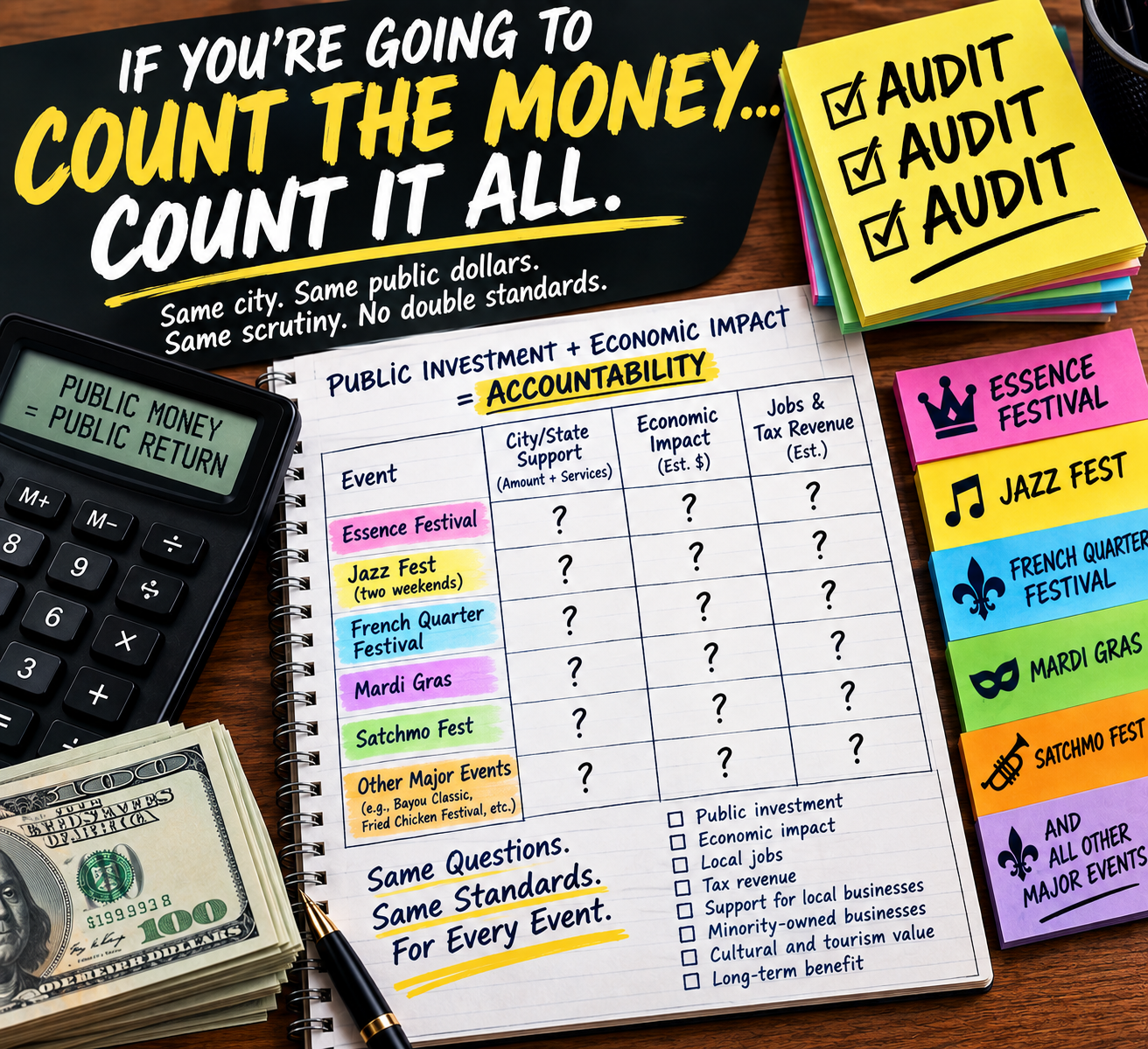
Let us be clear about something before this conversation gets any further:
Nobody is saying Essence Festival is perfect. Nobody is saying the City of New Orleans should blindly agree to whatever Essence asks for in a new contract. And nobody should be afraid to ask hard questions about public money.
Those questions are appropriate.
But if we are going to have a serious conversation about the public investment in events like the Essence Festival, then let’s have the whole conversation—not just the part that makes this investment look questionable.
The Louisiana Legislative Auditor is asking the City of New Orleans to account for the public money associated with Essence. Fine. The public deserves transparency about how its money is spent.
But transparency cannot mean examining Essence in a vacuum. Somebody has to be willing to say that – plainly, clearly, without fear and with their entire chest. Guess that’s us.
New Orleans supports major events all the time.
The City provides financial support, public safety, permitting, infrastructure, departmental coordination, public-space management, tourism promotion and other services to major events throughout the city.
Jazz Fest receives public support.
French Quarter Festival receives public support.
Mardi Gras receives public support.
Major sporting events and other large-scale events receive public resources and services.
In fact, the City’s own New Orleans Tourism and Cultural Fund says that since 2021 it has invested more than $3.6 million in sponsorships for local festivals, including Jazz Fest, French Quarter Fest, Satchmo Fest, the Fried Chicken Festival, Bayou Classic and Essence. And that is just funding from a small agency with the narrow focus of helping to promote and support culture bearers and cultural events. It does not include the direct financial support, sponsorship and massive infrastructure support (police, permitting, emergency services, etc.) that come directly from the City of New Orleans. Those festivals generated an estimated $1.2 billion in economic impact for New Orleans and Louisiana.
So the question isn’t simply: “Why does the City give money to Essence?”
The questions should be: “How much does the City and the state invest in major events across the board? What form does that investment take? And what does the public receive in return?”
Let’s Talk About the Return
Let’s be real about what Essence does for New Orleans.
The City’s own Cultural Impact Report has estimated the economic impact of Essence Festival at approximately $350 million, along with more than 2,000 jobs and nearly $50 million in federal, state and local tax generation.
That is not pocket change. That’s hundreds of millions of dollars moving through a local economy in one festival weekend.
Hotel rooms. Restaurants. Bars. Transportation. Retail. Entertainment. Local vendors. Convention space. And all the other businesses that benefit when hundreds of thousands of people come to New Orleans and spend money.
Essence has also been bringing enormous numbers of visitors to New Orleans for more than 30 years. The festival has routinely drawn more than half a million attendees, and its programming extends beyond the nightly concerts into business, wellness, career, fashion, beauty, empowerment and community programming.
So no, we are not going to sit here and pretend that New Orleans’ investment in Essence has produced no return. And we are not going to allow the legislative auditor’s questions or anyone else’s erase what we know to be true.
Now let’s compare it to Jazz Fest. Jazz Fest is a tremendous economic engine for this city too.
The City’s own Cultural Impact Report put the economic impact of the New Orleans Jazz & Heritage Festival at approximately $400 million. For 2026, projections were even higher, with an estimated $500 million economic impact and approximately 500,000 visitors.
Now remember: Jazz Fest is a two-weekend festival.
So let’s put the numbers on the table.
Essence: approximately $346–350 million in economic impact.
Jazz Fest: approximately $400 million historically, with 2026 estimates reaching $500 million.
They are both two enormous economic engines.
One happens over a three-day Fourth of July weekend.
The other happens over two weekends.
And both bring hundreds of thousands of people into this city.
That is precisely why we want the public conversation to be broader than, “How much money did Essence get?”
Let’s ask:
How much public money does New Orleans invest in Jazz Fest?
How much does it invest in French Quarter Festival?
How much does it invest in Mardi Gras?
How much does it spend providing police, traffic management, sanitation, permitting, public works, emergency management, public-space management and other services for those events?
And then: What economic return does each event produce?
Because if we’re going to determine whether Essence is “worth” the public investment, we need to know what we’re comparing it to.
And here’s the part The New Orleans Tribune refuses to ignore: Essence’s economic value isn’t only about the number at the bottom of an economic-impact study.
Essence brings a specific audience to New Orleans – a massive Black audience. It is also an audience that spends money, fills hotel rooms, eats in restaurants, shops, uses transportation, goes to attractions and extends its stay. It spends money with Black-owned businesses and other local businesses. And it turns New Orleans into a national destination for Black travelers over the Fourth of July weekend.
That matters.
Race is part of this conversation. Let’s stop pretending it isn’t.
Essence is not simply another music festival. It is one of the country’s largest celebrations of Black culture, music, entertainment and community. That cultural identity is part of the reason people come.
And that cultural identity has economic value.
New Orleans understands this better than almost any city in America. We monetize our culture every single day. We market our food, our music, our Mardi Gras, our festivals, our history, and our Black cultural traditions.
So we should not suddenly become uncomfortable acknowledging that Black cultural tourism is also an economic asset.
That does not mean Essence should receive a blank check.
It does not mean Essence should automatically get whatever it asks for.
It does not mean the City shouldn’t demand accountability, transparency, benchmarks and measurable results in a new agreement.
It means the cultural and economic value of what Essence brings to New Orleans has to be part of the calculation.
And this is where the next contract matters.
If the City decides that Essence is no longer worth the level of investment it has historically received, that might be a legitimate policy decision.
If the City decides that Essence must meet new benchmarks before receiving public support, that’s legitimate too.
If the City ultimately decides to put the Fourth of July weekend out for a competitive process, that’s a decision the administration can make.
But then apply the same standard to everybody.
And if the City is wants to send out an RFP and put money on the table for a major Fourth of July event, tell us what that that money is supposed to buy.
How many visitors?
How many hotel nights?
How much local spending?
How much tax revenue?
How many local jobs?
How much local procurement?
How many New Orleans businesses benefit?
How many minority-owned businesses benefit?
How many local artists are hired?
What is the media value?
What is the year-round economic impact?
What is the cultural value?
And what happens if the event doesn’t deliver?
Apply those standards to everybody.
Because if New Orleans decides to replace Essence with another festival and then gives that festival essentially the same public investment Essence already receives or the new investment it is seeking, we are going to have a very simple question:
Was the problem really the amount of public money being invested in a major Fourth of July event—or was the problem the particular event and the particular audience it brings to New Orleans?
And if that replacement event does not bring the same economic return, the same number of visitors, the same hotel demand, the same local spending, the same cultural tourism, the same Black consumer audience and the same benefit to New Orleans businesses, then the City cannot simply call the two investments equivalent because both happen to involve music and tourism.
They aren’t necessarily equivalent.
That’s why we want to see the numbers. Not just Essence’s numbers. Everybody’s numbers.
If we’re going to count the money, count it all. If we’re going to audit the investment, audit the entire system. If we’re going to compare events, compare them honestly.
And if we’re going to decide what New Orleans is willing to spend to attract and retain major events, then establish the criteria, publish them and apply them equally.
But don’t tell us that Essence has somehow failed New Orleans simply because New Orleans has invested in Essence.
The investment has produced a return.
The City’s own numbers say so.
The question now isn’t whether Essence has been worth anything to New Orleans.
The numbers make clear that it has.
The question is whether the current Essence Festival is delivering enough value to justify whatever the City ultimately agrees to invest in its future.
And if the answer is no, then let’s say that.
Let’s negotiate harder. Let’s demand more. Let’s require measurable deliverables. Let’s hold Essence accountable.
But let’s also be honest about what we’re giving up if we walk away—and honest about what we’re going to demand from whoever comes next.
And we want those questions answered whether the event is Essence, Jazz Fest, French Quarter Festival, Mardi Gras—or somebody we’ve never heard of before.
That’s fairness. That’s accountability. And that’s how you have this conversation without playing games.