
Government Efficiency is Code for “Poor People Pay the Price” and Guste Homes is the Latest Target
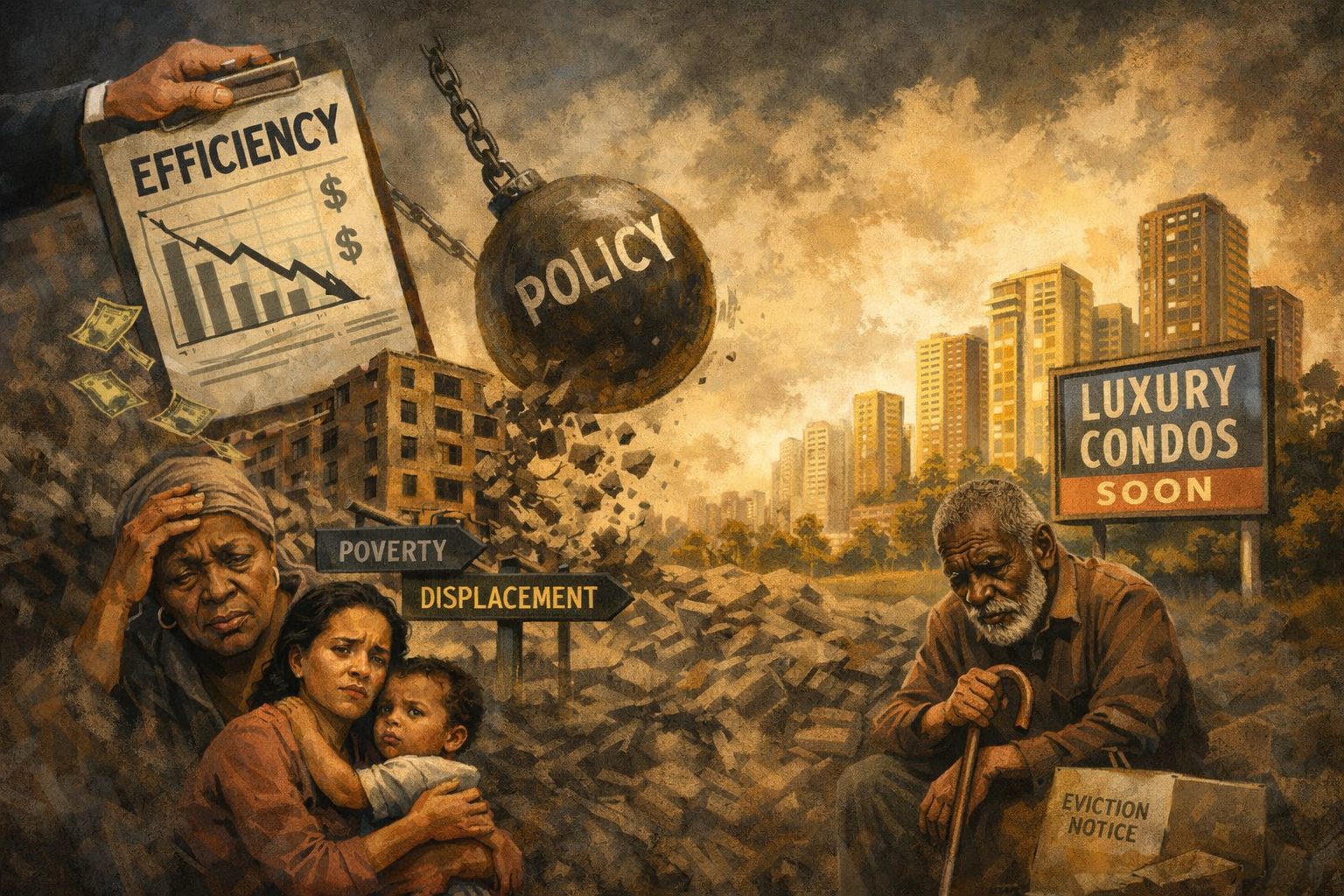
Talk of displacing 300 elderly public housing residents is reprehensible. This city has already endured one generation of housing upheaval. We should not be preparing another — especially one that targets poor, elderly Black residents.
Any time the government starts talking about “efficiency”, we know poor people are about to pay the price.
That is exactly what is happening now with the federal scrutiny of Guste High Rise. Officials are calling it responsible oversight. But to longtime residents of this city, it feels like the same playbook that has already stripped New Orleans of thousands of deeply affordable housing units. And now it is aimed squarely at the most vulnerable – poor, elderly residents who have the least ability to recover from displacement.
Somebody has to say it: balancing budgets by destabilizing poor seniors is not reform. It is abandonment and disregard dressed up as policy.
Same, Old Two-Step
Let’s stop pretending we don’t remember what happened here. And let’s not act as if the numbers are complicated. Because they aren’t. Before Hurricane Katrina, New Orleans had more than 7,000 traditional public housing units available to low-income residents that needed it most. Today, that number sits at roughly 2,100. That’s less than 70 percent of the pre-Katrina stock. That math did not support the narrative of “making things better” then, and it does not support it now. Thousands of low-cost units were destroyed and never replaced. Meanwhile, the demand for affordable housing has only grown in a city where the median income for Black households sits somewhere between $30,000 and $36,000 a year and the poverty rate is estimated at 30 percent for Black residents – nearly triple the 11 percent poverty rate for white residents.
Somebody has to say it: this is not about efficiency. It is about priorities. And poor people, especially, poor Black people, have never been a priority.
After Katrina, public housing in New Orleans was not gradually improved — it was decimated. Entire communities were demolished under the promise that mixed-income redevelopment would create safer neighborhoods and more opportunity. We were told replacement housing would meet the need. We were told vouchers would provide flexibility. We were told no one would be left behind.
We knew better. Today, affordable housing is one of the city’s most severe crises.
Drive past many of the so-called revitalized developments and you will see something few people, including federal housing officials are willing to acknowledge: vacancies. Empty units exist within the very mixed-income and post-HOPE VI communities once held up as the national model. Those vacancies do not trigger emergency federal reviews. Those properties are not suddenly labeled financially unsustainable. No one is proposing to shut them down, especially since the vast majority of them are rented at market rates the working poor cannot afford.
So why Guste?
The uncomfortable answer is who lives there. Poor residents. Senior citizens. Black people. People without political leverage or development partners advocating on their behalf.
And let’s be honest about another reality many residents already understand. We have seen this movie before. The language of “efficiency” and “improvement” too often becomes the opening chapter of redevelopment deals where public land quietly becomes private opportunity. Yes, we are skeptical and suspicious. We have reason to be, and we would not be shocked if, somewhere down the line, clearing Guste suddenly makes way for upscale redevelopment, high-rise condos, or market-rate housing carrying price tags far beyond what working-class New Orleanians could ever afford. For the better part of the last 20 years, housing policy in New Orleans has sounded and looked more like a real-estate prospectus. We have every right to ask who truly benefits.
Let’s Be Real: Government Policy
Created the Problem
For the residents of Guste High Rise, this is not an abstract policy discussion. These are elderly people living on fixed incomes, dependent on nearby hospitals, bus lines, pharmacies, and neighbors who check on them daily. A housing voucher may look efficient on paper, but paper does not locate accessible apartments in a tight rental market. Paper does not replace community. What makes this moment especially frustrating is that federal housing policy helped create the very conditions now being used as justification for this so-called intervention. Density was reduced. Public housing inventory shrank. Replacement units never matched what was lost. Now the few remaining buildings are criticized for being expensive — as if neglect and shrinking supply were accidents instead of the result of intentional policy choices.Local Leadership
Can’t Rollover . . . Again
Yes, we know this review is coming from Washington. But local leadership does not get to stand silently on the sidelines. New Orleans officials were elected to protect the people who live here — not simply manage federal directives. This is a moment that calls for advocacy, not quiet compliance. Not a repeat of 2007 when the New Orleans City Council approved the demolition of about 4.500 public housing units. Instead, city and housing leaders must make it unmistakably clear that elderly residents are not disposable and that federal pressure will be met with local resistance when community stability is at stake.
New Orleans seniors should not be punished because federal math has decided that compassion is too costly.
If HUD wants to talk about efficiency, start by explaining why vacant mixed-income units are tolerated while occupied senior housing is questioned. If the goal is stability, invest in modernization instead of threatening displacement. And if the federal government truly believes in equity, it must stop treating deeply affordable housing as expendable infrastructure.
This city has already endured one generation of housing upheaval. We should not be preparing another — especially one that targets poor, elderly Black residents.