
The New Orleans Tribune Announces Transition to Digital-Only Publication
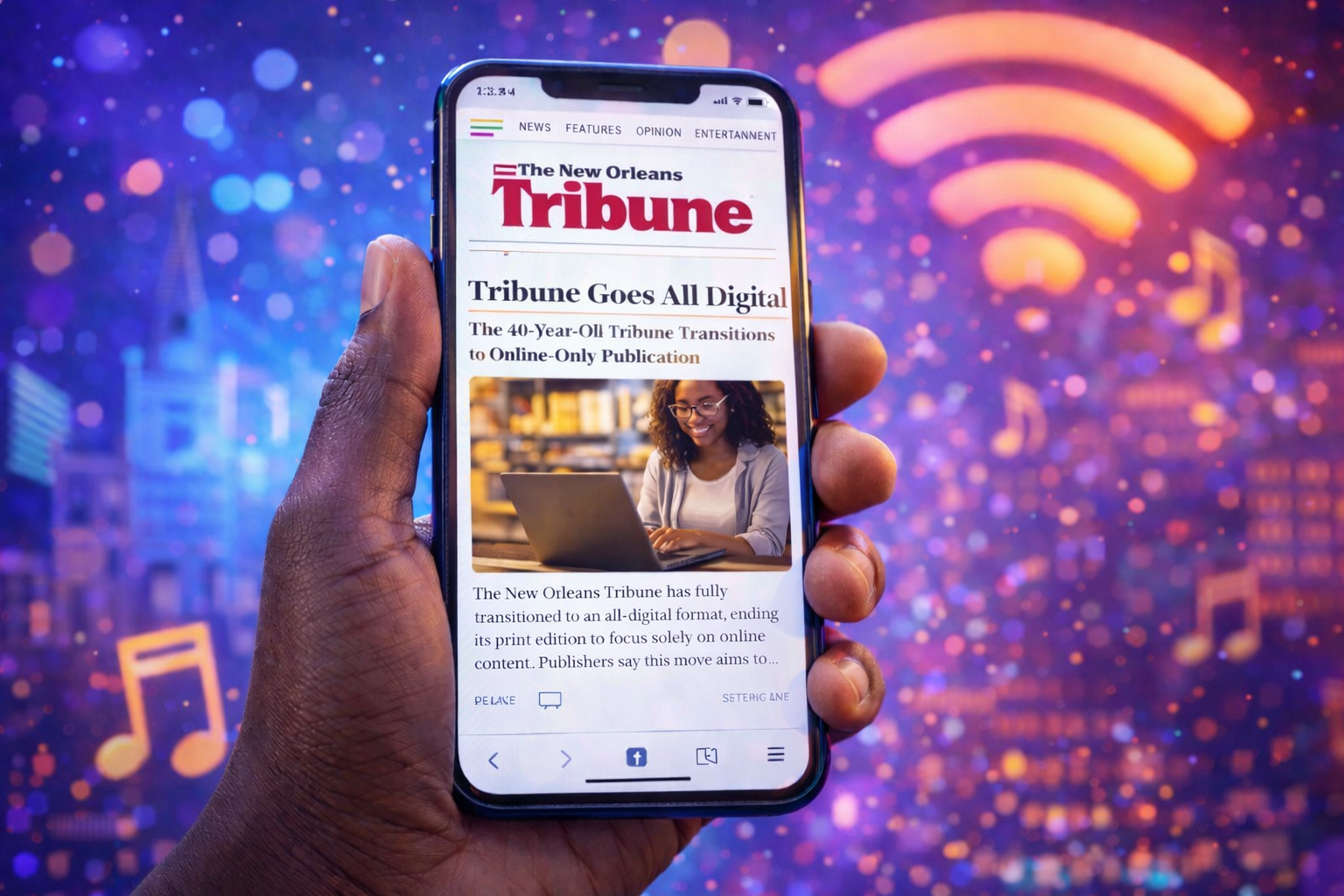
40-year-old Tribune will shift to online-only publication as passion for and commitment to community remain steadfast
By Danielle Coston
The New Orleans Tribune
After much reflection, McKenna Publishing Company is officially announcing that The New Orleans Tribune, the well-respected news magazine founded 40 years ago, will pivot to a digital-only publication.
This decision is driven by several factors, including changes in how and where people consume news and information, the impact of digital media on print revenue, and the strategic use of limited resources.
While McKenna Publishing’s owners and staff understand that many members of the community will miss the monthly print issue—with its vibrant covers, attention-grabbing headlines, and hard-hitting editorial from an unapologetically Black perspective—the profound transformation of the media landscape cannot be ignored.
Today, a vast majority of people consume news online using smartphones, tablets, and computers. Unlike print media, which is published on a fixed schedule, digital journalism allows for real-time updates and immediate access to breaking news. Digital platforms also support richer storytelling through multimedia elements such as video, audio, podcasts, and interactive graphics.
In short, the way people access news has evolved dramatically with the rise of the internet and mobile technology. While that evolution has been exciting, its impact on print media has been severe. Since 2005, nearly 2,900 newspapers nationwide have either closed or merged. According to the Poynter Institute, an average of 2.5 newspapers closed every week in 2024.
Compounding these challenges is the long-standing reality that Black-owned media outlets have historically received less investment from advertisers than their mainstream counterparts—despite their cultural relevance, credibility, and community reach.
In response, The Tribune will eliminate the significant costs associated with printing and distribution and reallocate those resources toward strengthening its digital infrastructure, expanding content creation, and enhancing the reader experience.
The New Orleans Tribune is not alone in making this transition. Across the country, both mainstream and historically Black newspapers are confronting the same realities and audience shifts that have reshaped journalism in the digital age. In recent years, legacy publications have been forced to rethink long-standing print models as advertising revenue declines, production costs rise, and readers increasingly turn to digital platforms for news.
For examples, The Atlanta Journal-Constitution, one of the South’s most influential newspapers, announced the end of its daily print edition effective Dec. 31, shifting to a primarily digital-first strategy with limited print distribution. The Chicago Defender, one of the most influential Black newspapers in the nation, transitioned years ago from its iconic print legacy to a digital-only platform. These decisions underscore a shared reality: the future of journalism—whether mainstream or Black-owned—now depends on meeting readers where they are, while preserving the mission, voice, and community accountability that made these institutions essential in the first place.
That is what The Tribune is doing.
As The Tribune marks this turning point, it also reflects with publisher Dr. Dwight L. McKenna, co-publisher Beverly Stanton McKenna, and longtime editor Anitra Brown in the following Q&A.
The Tribune: As we come to this pivotal moment, could you remind readers how the modern-day Tribune came to be?
Beverly McKenna: The story is one we have shared many times. We watched with quiet indignation as our community was unfairly and inaccurately depicted in mainstream media. Nearly every story focused on negative portrayals of our people, our leaders, and our neighborhoods. But we knew better. We knew our history and our communities were worthy of celebration.
We also understood that we could not wait for others to be honest, fair, or equitable. There was another perspective that needed to be highlighted, and we had to highlight it. There was another voice that needed to be raised, and we needed to raise it. As the African proverb says, “Until the lion writes his own story, the tale of the hunt will always glorify the hunter.”
The Tribune: It takes courage to say, “I’m going to publish my own newspaper.” What was that process like?
Dr. Dwight McKenna: It took a great deal of planning and preparation. We were fortunate to have people like our founding editor, James Border, and Kermit Thomas, who helped guide marketing and advertising in the early years.
But it was more than courage. It was the belief that when something needs to be done, you do it. We cannot wait for others to save us or do right by us—we must do it ourselves. That principle has guided The Tribune from day one.
The Tribune: How difficult was the decision to transition to an all-digital publication?
Beverly McKenna: It was difficult. For 40 years, The Tribune has served as an essential voice in our community, saying what no one else would say in ways no one else could. But the question became: how do we best use our resources while remaining that unfettered voice our readers trust? We discussed this at length. In truth, we delayed making a public announcement because part of us thought we might change our minds. We didn’t.
This move — consolidating our efforts and amplifying our voice online — makes sense. The Tribune has had a digital presence for more than 20 years, beginning after Hurricane Katrina, when New Orleanians were dispersed across the country. We built e-newsletters, a website, and social media while continuing to publish monthly in print. Ending the print edition was hard—but focusing fully on digital was easy. That’s where readers are.
The Tribune: What can readers expect moving forward?
Anitra Brown: This transition is exciting. By focusing our resources, we can deliver news more frequently and expand the range of content we provide. Let’s also note that McKenna Publishing will still print Welcome, our annual guide for Black tourists to New Orleans. And the door is always open for special edition print issues.
Beverly McKenna: And let us be clear—our voice is not changing. We will continue speaking to, for, and about the Black community from a perspective you will not find elsewhere. The Tribune will still say what needs to be said, especially when no one else will, because Somebody Has to Say It.
The Tribune: What should readers do now?
Anitra Brown: We are the same New Orleans Tribune—now exclusively digital. Follow us on social media, visit www.theneorleanstribune.com, and subscribe to our e-newsletter so you won’t miss a beat. For our advertising partners, there are great opportunities to join us on this journey. For information on digital packages and rates, email us at info@mckennapublishing.com.