
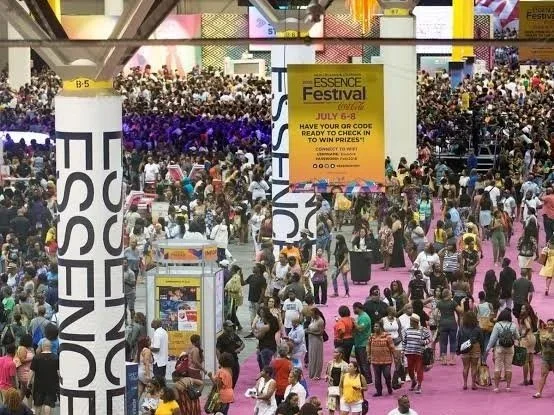
There is something particularly troubling about the way New Orleans has arrived at this moment with Essence Festival.
After 33 years, the festival that became one of the most recognizable celebrations of Black music, culture, entrepreneurship and influence in the country will no longer call New Orleans home in 2027. And while there is plenty of finger-pointing to go around, plenty of letters to read, press releases to issue and public explanations to offer, perhaps it is time to stop getting caught up in everybody's version of who is to blame and take a harder look at what actually happened.
Because, at the end of the day, this was a business deal. And the business deal fell apart.
Let's not pretend that Essence simply woke up one morning and decided New Orleans was no longer a suitable home. Nor should we pretend that the city did everything within its power to keep a 33-year institution that brought thousands of visitors, millions of dollars in economic activity and invaluable national attention to this city.
The magic that New Orleans brought to the festival simply cannot be replicated anywhere else. After all, this is arguably the most Africanized city in America, and Essence Festival will not be the same outside of New Orleans. It will be something else. And that’s okay, we suppose.
The truth is, if both parties had been sufficiently committed to reaching an agreement, there would have been room for compromise. There would have been a deal. Instead, we are left with competing explanations, public disagreements and both a city and a festival that seem prepared to move on without fully reckoning with what either is losing.
And that is the part that deserves our attention.
We have heard the arguments about the city's obligations, the festival's demands, vendors, contracts and the various parties who believe the other side failed to do what it was supposed to do. We have watched the public back-and-forth. But somewhere beneath all of that is a much more fundamental question: Did this administration ever really intend to keep Essence here?
We cannot say with certainty what was being discussed behind closed doors. But we can say that the outcome is beginning to look less like an unfortunate breakdown in negotiations and more like the fulfillment of a direction this administration was willing to take all along.
And if this was the plan all along, New Orleans residents deserve an honest accounting of it.
We were not just defending a festival. We were defending an institution.
For more than three decades, we have watched Essence grow into something much bigger than a Fourth of July concert weekend. We were here when there were people who questioned whether a festival designed for Black people, celebrating Black culture and bringing Black consumers together could work in New Orleans. Some could not quite understand the vision. Others seemed unable to appreciate the possibilities.
We understood them.
We understood what it meant to bring Black people from across the country to a city whose culture, music, food, history and identity are so deeply rooted in Black life. We understood what it meant for Black businesses, vendors, musicians, hospitality workers, entrepreneurs and cultural institutions to have access to an audience that might otherwise never find its way to them.
And we said so.
We defended the festival. We argued for its economic and cultural value. We challenged the suggestion that the public investment was somehow unjustified without applying the same scrutiny to the public investments made in other major festivals and events throughout this city.
That was never an argument that Essence should be above accountability. Vendors deserve to be paid. Contracts must be honored. Public investments deserve transparency. But accountability cannot be a standard applied selectively, and economic value cannot be dismissed simply because the institution generating it is Black-centered.
We are sad to see Essence leave. We are allowed to be sad about that. We were here from the beginning, and we recognize what three decades of this relationship have meant to New Orleans.
We wish Essence well wherever it lands. We will be watching, and we will be there to see what this festival looks like in a city other than our own.
But we are also going to be watching New Orleans.
Now, about this new Black cultural celebration...
Even before the final announcement, there had been rumblings that city officials were already exploring the possibility of bringing another major festival to New Orleans. We were paying attention then, and we are paying attention now.
On November 24, Mayor Helena Moreno acknowledged that the city was working toward a new Black cultural event for the Fourth of July weekend. Reports indicate that tourism leaders and members of the mayor's steering committee have been meeting with festival producers. The administration has promised a major event featuring national entertainment, local artists, musicians and opportunities for Black-owned businesses. Details are expected to be unveiled December 9.
Well, all right.
We certainly believe New Orleans should have a major Black cultural celebration. We believe the city should have one every year. We believe our culture deserves national recognition, our artists deserve national platforms, and our businesses deserve opportunities to benefit from the tourism economy that our culture helps generate.
But before anybody starts selling us on the next big thing, we have some questions.
Who?
Who are the producers? Who are the organizers? Who owns the production company? Who is responsible for the creative vision? Who will control the contracts? Who will receive the production fees? Who will benefit financially from this enterprise? Who will be enriched by it?
Because we want to be very clear about something: If this is going to be a celebration of Black culture, then Black people must be more than the faces on the promotional materials, the performers on the stage, the speakers on the panels and the community members invited to attend.
We want Black people producing it. Black people organizing it. Black people making the business decisions. Black people holding the contracts. Black people with ownership interests and meaningful financial stakes in the enterprise.
We are not interested in another arrangement in which Black culture is the attraction, Black people are the audience, Black artists provide the entertainment, and somebody else walks away with the wealth.
We will not sit by and watch our culture become the vehicle through which others get enriched while the people whose culture it is are left fighting for a piece of the economic benefit.
And this is not an unreasonable demand. It is not an attempt to shut anybody out. It is a demand that a celebration of Black culture be structured in a way that respects Black ownership, Black expertise, Black entrepreneurship and Black economic interests.
If the administration is serious about creating something else, it should have no difficulty being transparent about who is behind it.
And we want to know whether the people being considered for this production have demonstrated a commitment to Black cultural ownership, not simply an ability to package Black culture for commercial consumption.
There is a difference.
We have seen this movie before.
There is another reason we are approaching this new development with a healthy dose of skepticism.
Quite frankly, we cannot shake the feeling that this administration was prepared to move on from Essence long before the public was told that the relationship was over.
Look, let’s get real. If you believe that it’s all just happenstance that the day the negotiation failure is announced publicly, the administration already has new plans for another festival, there is a some land we want to sell you about, oh, 30 miles south of Venice, La.
We don't know what conversations were happening behind closed doors. We don't know how far along discussions with prospective replacement producers were when negotiations with Essence were still supposedly underway. But the timing, the rumored discussions and the administration's apparent readiness to move forward raise legitimate questions.
Was this simply a contingency plan? Or was there already a preferred alternative?
Those are not the same thing.
And the people of New Orleans have a right to know.
The administration cannot spend months publicly debating the future of an established institution, allow negotiations to collapse, and then expect residents to embrace a replacement without asking who developed the plan, who was involved, and whose interests it serves.
We also don't want to hear that the new festival will be better simply because it promises more local participation. That sounds wonderful. But promises are not contracts. Announcements are not ownership. And putting Black businesses on a list of potential participants is not the same as ensuring they have meaningful opportunities to make money.
We want specifics.
We want to see the proposed ownership and production structure. We want to know how Black-owned businesses will be selected and compensated. We want to know what percentage of the production budget will remain with Black-owned companies. We want to know who controls the intellectual property, sponsorship relationships, vendor contracts and revenue streams.
And we want those answers before the city asks the public to celebrate.
Wait, there’s more we need to say, because somebody has to...
There is a political dimension to all of this that we would be remiss not to acknowledge.
Decisions have consequences. Relationships have consequences. The way an administration approaches longstanding partnerships has consequences.
We are not suggesting that Essence should have been permitted to operate without accountability. We have never made that argument. But there is a difference between holding a partner accountable and allowing a relationship that took more than three decades to build to deteriorate to the point that neither side can find a way forward.
And there is a difference between being prepared for what comes next and appearing to have been waiting for the opportunity to replace what was already here.
New Orleans loses something when Essence leaves. We should not minimize that loss simply because somebody is promising something new.
We are sad. But we are watching.
There is no joy in seeing Essence leave New Orleans. We know what it took to establish this festival here. We remember when its possibilities were questioned. We remember the arguments about whether a celebration created for Black people, by Black people, could become an economic and cultural powerhouse in this city.
It did.
And we were among those who understood its significance and defended its place here.
We hope cooler heads might eventually prevail and that, one day, there could be another conversation about Essence and New Orleans. Until then, we wish the organization well. We will follow its next chapter and see what it becomes in another city.
But New Orleans has some explaining to do, too.
We want the December 9 announcement. We want the names. We want the companies. We want to know who is producing this new celebration of Black culture and, more importantly, who stands to benefit from it.
Because we have no interest in watching New Orleans lose one Black cultural institution only to replace it with an arrangement that separates Black culture from Black economic ownership.
If we're going to celebrate Black culture, let's make sure Black people are doing more than showing up to celebrate it.
We want to see Black people at the table, at the head of the table, signing the contracts, making the decisions, owning the production and sharing in the wealth.
That is not too much to ask.
That is the very least we should expect.
Somebody has to say it.