
Somebody Has to Say It: New Orleans East Never Needed a Vision. It Needed the Same Commitment Given to Other Parts of the City
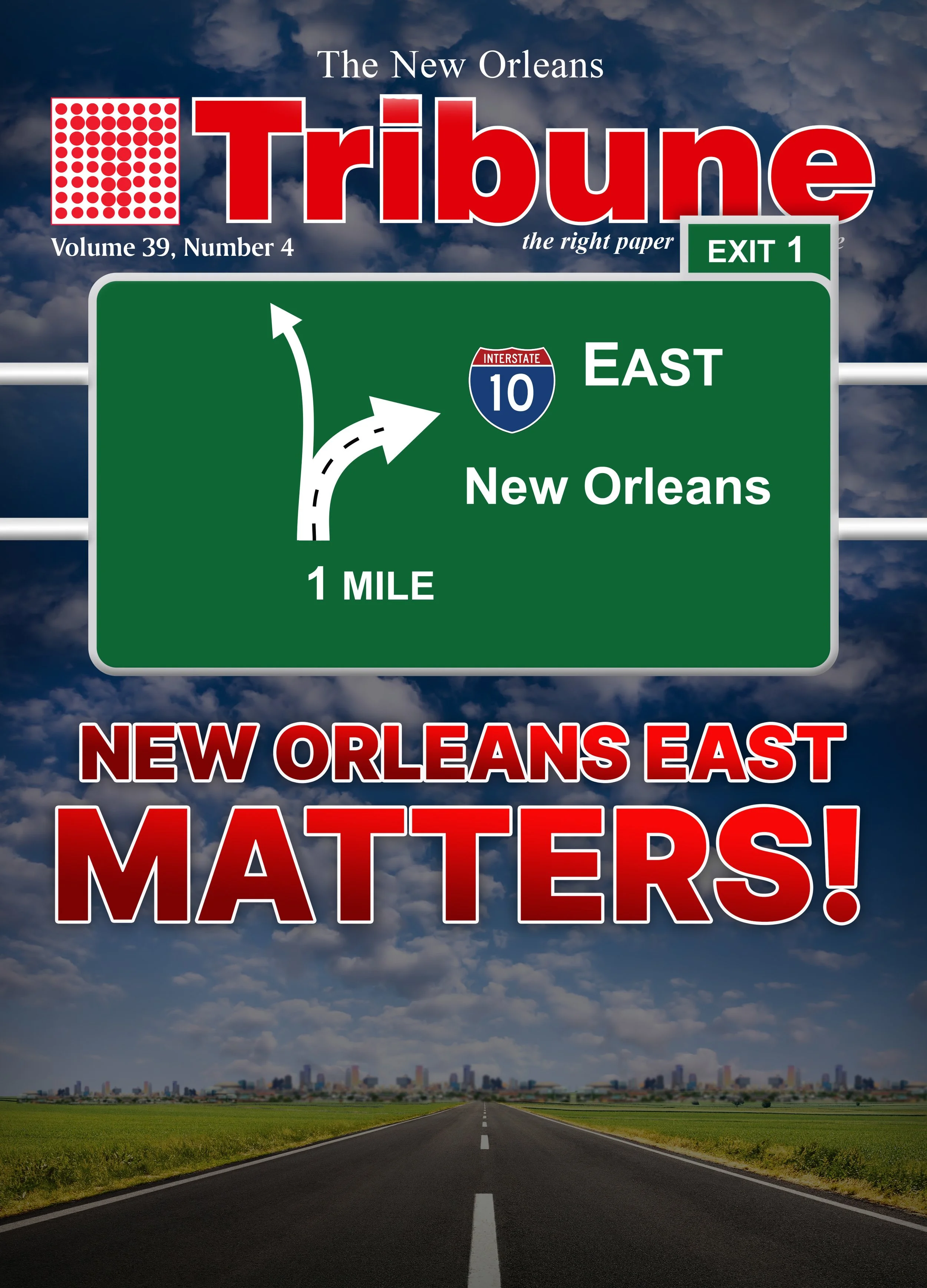
The April 2023 cover of The New Orleans Tribune serves as just one of many examples of this publication using it voice to promote and champion New Orleans East throughout the years.
The recent headline announcing Mayor Helena Moreno's vision for New Orleans East focuses on investment, jobs, and economic redevelopment. We welcome it.
In fact, we applaud any serious effort to bring good-paying jobs, new businesses and economic development, improved infrastructure, and increased opportunity back to one of the city's most important communities.
But somebody has to ask why a community whose potential has been obvious for decades is only now being treated as if it is worthy of sustained investment. Why do the East and its assets suddenly matter when they have always been there? What roles have politics—and yes, race—played in delaying the investment that residents have long deserved.
Yep, those are questions we are willing to raise and conversations we are willing to have, because somebody has to say to.
New Orleans East has never lacked potential. It has never lacked land. It has never lacked people. It has never lacked opportunity. Those are not new discoveries. They are long-standing realities that its residents, business owners and community advocates have understood for decades.
The East didn't become valuable overnight. What has been missing is the political will to invest.
And let's be clear the absence of political will did not happen by accident. Neither did the East’s decline. From white flight in the late 1960s and 1970s that resulted in disinvestment and chronic neglect in the decades that followed, from an inequitable rebuilding program after Hurricane Katrina that devalued homes in Black neighborhoods, making it harder for residents to return, to the negative tropes – its decline was by design.
There were people that wanted to see New Orleans East wiped off the map and turned into “green space” after Hurricane Katrina. Now suddenly, it represents one of the city’s greatest opportunities for economic growth.
We agree. It does. In fact, at The New Orleans Tribune, we've long known that truth. It is the reason we have urged Black residents to not sell land and property they own in the area even as the roadways were littered with signs declaring “We Buy Houses for Cash.” It is the reason we have featured the East on our cover more times than we can remember over the last four decades – stories that not only extolled it’s potential, but highlighted the positive things already taking place there despite pervasive and unfair negative narratives perpetuated by mainstream media.
That's is exactly what has us wondering why proposals that recognize the East's value have seemed to gain momentum and acceptance now.
The investment opportunities, the workforce, the developable land, the strategic location and the people were there last year. They were there a decade ago.
New Orleans East does not need to be introduced to its own potential. It needs leaders, institutions, and investors who are willing to act on what has always been true. It needs the same momentum and support every other section of the city gets.
Don’t misunderstand our intent. Our question is not meant to diminish Mayor Moreno's plan. It is, however, meant to ensure that history is not rewritten. Because supporting this initiative does not require pretending the opportunity is new.
Let's Talk About It
So let's talk about why New Orleans East never received the same level of commitment that other parts of the city have enjoyed, because this wasn't simply a matter of missed opportunities. It wasn't just bureaucracy. It wasn't just bad timing.
We believe something deeper was at work.
For years, mainstream media helped cement an image of New Orleans East as a community defined by crime, blight, and decline. Every neighborhood has challenges, but few were branded by them as relentlessly as the East. Those headlines became “the” story, while the businesses, families, churches, schools, entrepreneurs, and everyday successes rarely received the same attention. Perception became reality, and perception has consequences. It influences investment. It influences lending. It influences development. It influences whether people see a community as an opportunity or a risk. It can even cause people to people to flee.
Then there was the politics—the deals made behind closed doors, the shifting alliances, the competing interests, and the power struggles that too often seemed to leave New Orleans East waiting while other priorities moved to the front of the line. Residents have watched project after project stall, promises come and go, and opportunities fade without ever receiving a clear explanation.
Consider what happened in 2022 when Mayor LaToya Cantrell announced that a big box store was coming to New Orleans East. Residents celebrated what appeared to be a major economic development victory.
Within hours, however, the corporation publicly stated that no deal had been finalized and that it had no new-store announcement to make. The public was left to believe the mayor had simply gotten ahead of the facts.
Perhaps she did. Or maybe she didn't.
We said then that we found it difficult to believe that the mayor of a major American city would publicly announce a project of that magnitude without believing the deal was substantially in place. We even questioned whether the deal had become a victim of the petty antics and infighting that defined the local political landscape at that time in an effort to make the former mayor look bad. If there were negotiations, objections, or competing interests that ultimately derailed the announcement, the public has never received a full accounting. Those unanswered questions matter because they speak to a larger concern: how often promising opportunities for New Orleans East have stalled because of something happening behind the scenes while residents were left with little more than disappointment.
And yes, we're going to say what others won't.
We believe race cannot be separated from this conversation.
New Orleans East is one of the Blackest communities in the city. We believe there were people who were perfectly comfortable allowing the narrative of decline to continue because they did not want to see the East become the next great success story for Blacks, about Blacks and under Black political leadership. We cannot claim to know every person's motives, but we can look at the patterns. We can look at what is prioritized, what is delayed, what is it ignored, what is celebrated, and when it’s celebrated. Those patterns raise legitimate questions.
If that makes some people uncomfortable, oh well. We are not here to make folk comfortable. We are here to say the things no one else will.
And now that we have, let us also say this: Are we encouraged by Mayor's Moreno's recent announcement? Absolutely. If this plan succeeds not only is it a win for the Mayor Moreno and New Orleans East, it is a win for all of New Orleans.
A Couple More Things
There are a few more things that must be said.
The first part is a message to New Orleans East residents and business owners: You’ve always known your community’s potential. That’s why you stayed. Guess who else knew it? Every outside developer and other outside interests ready and waiting to take part in this vision. Just like you, they have known all along that New Orleans East is primed for economic growth and development. They recognize that the city has no other place besides New Orleans East to grow.
Hold on, we need to whisper this part in your ears: They were waiting for you to leave. They thought disinvestment would do the trick. When that didn’t work, they were certain inequity in the wake of Katrina and negative stereotypes about blight and crime would seal the deal. But you held on. They are tired of waiting you out. So they have decided to come anyway. And for whatever reason, now looks like a good time for them.
Be vigilant. Demand transparency. Demand community input. Demand opportunities for local businesses and contracts for local entrepreneurs. The wealth created in New Orleans East must stay in New Orleans East. This redevelopment should not become another chapter in which outside interests arrive to profit from a community that its own residents sustained through its most difficult years.
To our leaders: Now that developers, investors, and policymakers are once again looking east, residents cannot be dismissed as spectators in the redevelopment of their own community. If New Orleans East is finally going to receive the investment it has long deserved, then the people of New Orleans East must have a seat at the table. Make sure that happens.
For decades, East residents carried their community when others wrote it off. They rebuilt after Katrina. They reopened small businesses. They kept churches alive. They raised families, paid mortgages, invested in their neighborhoods, and refused to abandon a place that so many others had already declared was finished.
The people who believed in New Orleans East when belief wasn't fashionable should not be pushed aside now that investment is “in.”
Here at The New Orleans Tribune, we are hopeful. When we look at the team that Mayor Moreno has surrounded herself with, like Deputy Mayor Renee Lapeyrolerie, a longtime leader with the best interest of community at heart, we believe Mayor Moreno understands the importance of ensuring that New Orleans East and its residents get ownership and share in the prosperity created by its redevelopment.
And we stand ready to do our part. Yes, we will report setbacks with honesty, ask difficult questions and hold our leaders responsible. We will also celebrate progress when it happens, tell the stories that go untold, and give credit where it is due. For prioritizing New Orleans East, Mayor Moreno deserves credit.
But let's tell the whole story. New Orleans East never lacked a vision. It lacked a sustained willingness to invest in the vision that already existed. For our city's sake, we hope that time has passed.