
And Another Thing with Anitra: Stop Telling Voters What They Can’t Do!
By Anitra D. Brown
The New Orleans Tribune
After the May 16 closed party primary, we have two Black candidates advancing to a runoff to determine who will be the Democratic nominee in the race for U.S. Senate. Which means — no matter what — one of them, either Jamie Davis or Gary Crockett, will be on the ballot in the fall against a white Republican, either Julia Letlow or Paul Fleming.
I was on the radio this week with a couple of other respected journalists/political commentators, recapping the recent primary; and at some point, the conversation turned to the U.S. Senate race — closed party primaries, June runoff, fall general election.
And right on cue, here comes the question:
Can a Democrat win statewide in Louisiana? Better still, can a Black Democrat win?
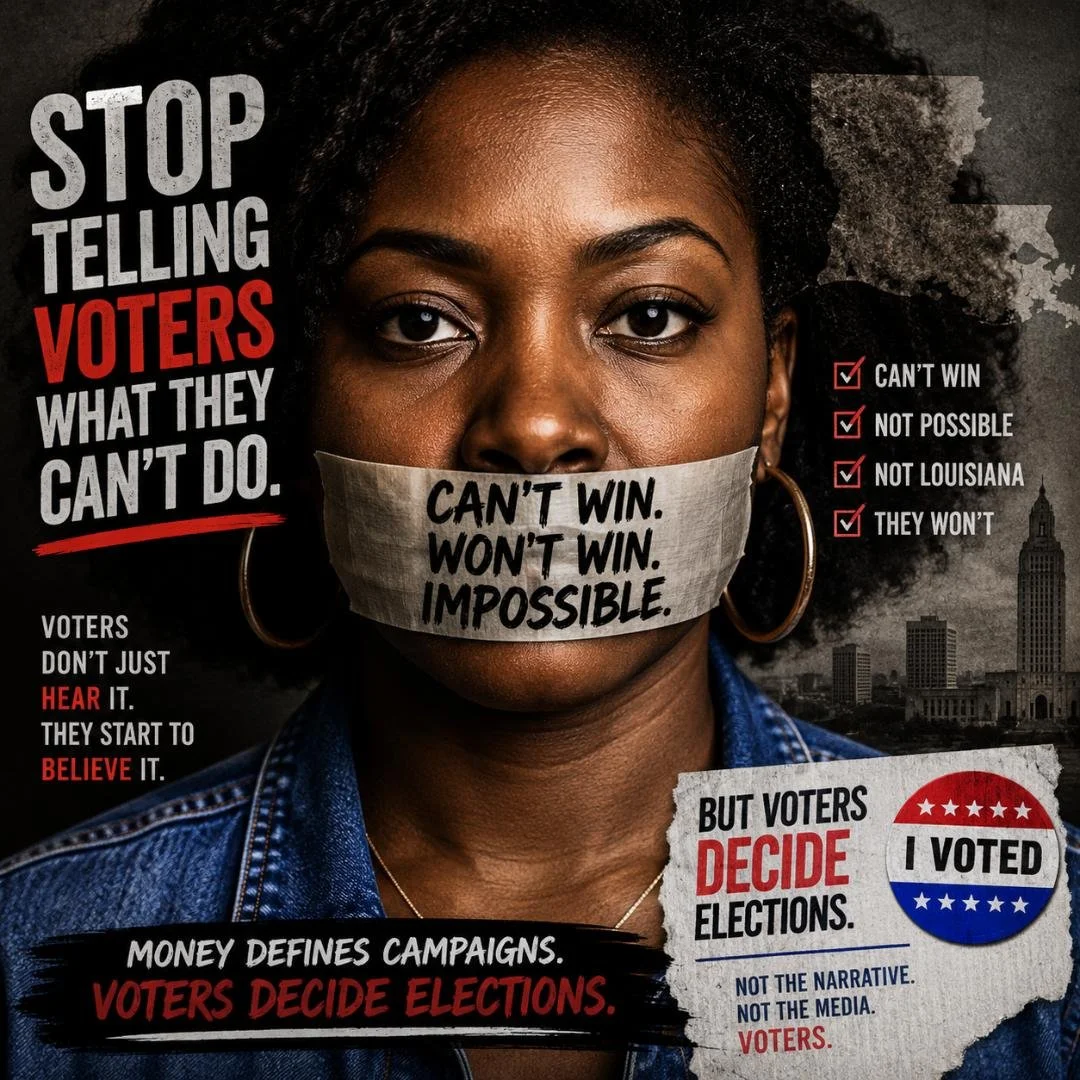
Let me tell you what I’m tired of: I’m tired of armchair analysis that starts and ends with what can’t happen.
That is not analysis. It’s a self-fulfilling prophecy.
Now look, I’m not naïve. I know exactly where I live. This is Louisiana, a red boot with a few blue spurs. Trump won here easily, and MAGA-minion Jeff Landry rode that wave, which was sprinkled with a little voter apathy, right on into the governor’s mansion. I understand the political landscape. I understand the challenges Democrats face statewide.
What I’m not going to do is pretend that voters are some fixed, predictable machine. Because they’re not.
Forgive me, but I am not comfortable with people (especially journalists) speaking in absolutes about what voters “won’t do” or about what “can’t happen.” So if you ask me can a Black Democrat or a Democrat who happens to be Black win the U.S. Senate seat in the fall, my answer will be “YES!” . . . if the right voters show up.
Think back. There were folks who were absolutely convinced in 2008 that this country would never elect a Black president. And then Barack Obama happened. Sure, it feels as if it was inevitable now. . . because he won. But let’s not pretend as if early on there was no skepticism. Many did not think a Black candidate could win a national election. Even in Black communities, hope was mixed with the question of whether America was ready to cross that line. And then there was a shift, and a coalition of voters – young, Black, liberal whites and independents made the implausible very real.
But hey, that is national politics. Let’s talk Louisiana, because we have receipts here, too, that at least prove a Democrat can win.
Mary Landrieu, a Democrat, was elected to the United States Senate. Not once, but three times.
John Bel Edwards, a Democrat, was elected statewide twice. His most recent win was not that long ago. And let’s not forget that Black voters across this state were key to his November 2019 win in the general election against Republican Eddie Rispone. Something like 468,000 Black voters — 50 percent of all eligible Black voters — cast ballots in that election, according to data available from the secretary of state. And they voted overwhelmingly in Edwards’s favor. I am not making this up people. Edwards got 774,498 votes. Rispone got 734,286, according to official election results. That’s a difference of just over 40,000 voters. If Black voters had not come out the way they did and overwhelming cast their ballots for Edwards, he would have lost.
I know . . . I know, I sound like a broken record. And that may be. But what I am not is wrong. Edwards would not have won without Black voters. Now if Black voters and liberal and progressive white voters can do that for a moderate, white Democrat in a statewide election, why can’t they do that for a Black Democrat?
And let’s deal with another argument that keeps pops up—the idea that somehow a statewide race for governor is different from a federal race for U.S. Senate, as if we’re dealing with two completely different electorates.
We are not. The same people who vote for governor are the same people who vote for U.S. Senate. Same voters. Same electorate. Same state. So don’t tell me what has happened in one race is somehow impossible in another when the ballots are being cast by the exact same people.
Now, does that mean the road is easy? No. Trust me, I am no Pollyanna. This will take heavy lifting. Voters who truly want change and who understand that the people they elect are the architects of the policy that impacts their lives must do a few things:
1) Pay attention and assess their quality of life and the condition of your community.
2) Connect the dots. Bad policy is not delivered by the Tooth Fairy, the Easter Bunny or the Grinch. It comes from bad policymakers. When someone shows you who they are, believe them. Oh, and stop electing them and people aligned with them to public office.
3) Show up and vote in a way that serves your interests. Voters just sent Gov. Landry a message by knocking down all five of amendments on the May 16 ballot, letting him know that his power-grabbing policies will not work for them. I could be wrong, but if the plan is to actually send the Landry a message, sitting back now and letting the MAGA candidate that he endorsed skateboard into the U.S. Senate would be insanely counterintuitive.
So can a Black Democrat win? Yes, but I need the pundits to sit this one out.
We’re Journalists,
Not Fortune Tellers
Look, with all that we have endured, I guess I still have faith in voters. So, when anyone asks me if a Black person or a Democrat can win statewide in Louisiana, I am going to “YES” every time, because the reality is that when people ask “can they win?,” what they’re really doing is shaping expectations before voters even get a chance to decide.
And that’s where I have a problem. When media voices and political commentators keep repeating that something can’t happen, that message doesn’t just sit out there. It seeps in. It affects whether people feel motivated to vote. It affects whether they believe their vote matters. It affects turnout.
And then when turnout is low, those same voices turn around and say, “See? We told you.”
NO! You helped create that outcome. That’s not analysis. That’s influence. And we don’t talk nearly enough about the role the media plays in that.
Our job is not to crown a winner or cast out a loser months in advance. Nor is it to tell voters what is or isn’t possible.
Our job is to lay out the facts, explain the stakes, show people how policies and leadership decisions directly affect their lives, and then step back so the voters do what they do.
The moment we start telling people that the outcome is already decided, we’re not informing them anymore. We’re discouraging them.
So, can a Black Democrat win a statewide race in Louisiana?
Honestly, I don’t know. You see, unleaded gas is $4 a gallon, so I just sold my crystal ball to get enough money fill up the tank in the car I can barely afford to drive because insurance is sky high — obviously a lot higher than the expectations some have of voters. So, I don’t know if a Black Democrat can win statewide. But I damn sure plan to find out.
I do know this: If we actually did our jobs as journalists instead of playing political fortune tellers, we might finally give democracy the space to do its job too.