
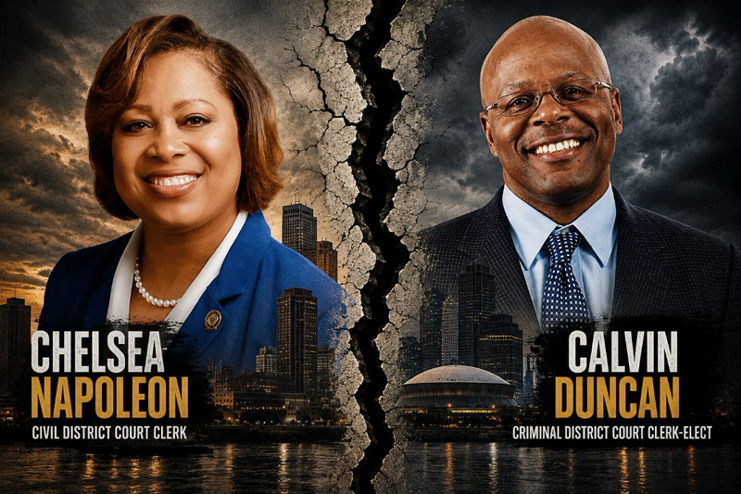
The state is wrong. But calling a special election and putting New Orleans voters in a position to choose between two duly-elected clerks will not make it right.
Two wrongs never make a right.
Yes, the state is overreaching. What the legislature has done is an intrusion into local governance — one with racist overtones. The attempt to eliminate elected positions and override local control should alarm anyone who believes in democracy.
But the Mayor and City Council’s decision to call a special election for a “consolidated” clerk seat is not the answer.
Not only does it not solve the problem, but it creates more division by ostensibly pitting the interests of two duly elected Black leaders against one another. We don’t like it.
Civil District Court Clerk Chelsea Napoleon should not be fighting for her seat. She should not have to sue. She caught a stray in a political fight that was never about her. But because Black political power was not protected in New Orleans, the integrity of local control and the will of the voters was not protected. We now have a situation where Napoleon is forced into a legal battle to hold on to what should never have been put in question in the first place. Yes, this is a failure of leadership. But it is not hers. It is a failure of the system — and the people — who allowed it to get this far.
We also agree that what happened to Calvin Duncan was a miscarriage of justice. Period. The people voted. And instead of respecting that vote, Republicans in the legislature shifted the ground underneath him after the fact. Duncan should continue pursuing all possible avenues to claim the seat he won. He should fight, and every elected official, influential leader, and voter in this city should stand shoulder to shoulder with him. We can start by sending Gov. Jeff Landry a booming message from the polls. We emphatically urge voters to knock down all five constitutional amendments on the May 16 ballot. Yes, we are talking to you. If you didn’t vote early, get up, go out and vote on May 16.
And if his legal appeal fails, Duncan will be well within his rights to run for the clerk’s position in 2029. The voters can decide. But until then, Napoleon should be left to do the work that she was elected to do while also balancing the new duties that have been thrust upon her by the new state law.
Now, Let’s Really Talk About It
We get it. You’re angry. You want to show those folk in Baton Rouge that they can’t push you around. We don’t like the state’s heavy-handed moves either. And this latest threat from AG Liz Murrill to oust other local elected officials reeks of racism and makes it abundantly clear that this new legislation was a targeted attack against Duncan.
But let’s think about this. What does calling a special election really solve? Does forcing the voters to choose between Napoleon and Duncan now undo the damage the state has done? The answer is “NO.”
In fact, you’re just asking the public to clean up a problem that local leadership helped to create. And that is the hard truth that few are willing to face. This moment didn’t start in Baton Rouge. It started right here.
For the past four years, instead of building a wall of protection around Black political power in this city, too many of our leaders were busy chipping away at it — publicly, repeatedly, and recklessly.
You took shots at your own. You undermined a sitting mayor. You played politics with the Home Rule Charter — not to protect the people, but to weaken legitimate, local power. And if you weren’t directly complicit in these acts, you sat back and watched it happening without saying a word.
And while you were doing that, the state was watching. Waiting.
Make no mistake. There has long been an appetite in Baton Rouge to control New Orleans, to dilute its autonomy, and yes, to minimize the influence of Black leadership in this city. And no, local leaders did not create that agenda, but they made it easier to execute. Even when given the opportunity to stand united behind Black leadership, this city’s leadership class wouldn’t do it. Not consistently. Not effectively. Not when it mattered most.
That disunity sent a message — a dangerous one.
It told the state: they are divided — go ahead.
So now, watching some of those same leaders scramble, calling special elections or positioning themselves as defenders of democracy, rings hollow.
Don’t misunderstand us. We applaud the audacity it takes to stand up to the state, but where was this clarity when the attacks were internal? Where was this backbone when it was time to stand together instead of score points?
Moreover, the City Council’s current response is the wrong move. Reacting after the fact is not leadership. It’s damage control. New Orleans deserves better. It deserves leaders who understand that protecting this city is not about who wins the latest petty, political feud. It’s about ensuring that outside forces never get the opportunity to dismantle what generations fought to build.
This Could Have Been Prevented
Yes, the state made its move. But it didn’t just find an opening. It was given one.
The destabilization of New Orleans politics over the past four years didn’t just stay local. It had major consequences.
We know some would rather conveniently forget the truth, but we will not. And here it is: We had a chance to stop this from happening, but we didn’t. If Black voters . . . and moderate Democrats across the state had shown up for Shawn Wilson in 2023 the way they did for John Bel Edwards just four years earlier, we might not be here. In 2019, Edwards received more than 400,000 Black votes. Four years later, only about 200,000 Black voters cast ballots for Wilson. Let that marinate.
Edwards would not have won without us. He only beat Eddie Rispone by less than 39,000 votes. Meanwhile, more than twice as many Black voters cast ballots in 2019 for a moderate White Democrat than voted in 2023 for a well-qualified Black man, also a moderate Democrat, who could have been the state’s first Black governor since Reconstruction. Now those 200,000 or so votes from Black Louisianans would not have resulted in an outright win for Wilson. But it would have been enough to keep Landry from winning in the primary. It would have forced a runoff, to be sure. And that would have meant more time for Wilson’s camp to gain momentum, build a stronger coalition among a cross-section of voters. A runoff could have triggered a bigger investment from the state and national Democratic parties. We could have made history, and we would not be here.
We said it in 2023, there was a path to get Wilson to Baton Rouge. And if local leaders in New Orleans had stopped their petty, political infighting long enough to pay attention to what really mattered at the time, we could have traveled that path together. Let’s not forget that Mayor LaToya Cantrell was a central figure in mobilizing Black voters in Orleans Parish during the 2019 gubernatorial race and is widely credited with helping generate the turnout that helped carry Edwards to victory in his final campaign. But by the time of the 2023 gubernatorial election, the same mayor had been so publicly weakened — through relentless attacks, internal division, and yes, a full-blown recall effort — that the Democratic candidate could not even fully anchor his campaign in New Orleans alongside her.
Let that sink in. In a majority-Black city that has historically been the backbone of Democratic victories in this state, the Democratic candidate for governor could not fully and publicly align with the sitting, Democratic, Black woman mayor of New Orleans.
Why?
Because the local political environment had become too fractured. Too hostile. Too unstable. Instead of building momentum for a gubernatorial race that should have demanded full, unified turnout, this city was consumed with internal battles, including a failed recall effort funded by big-monied Republicans with MAGA ties that did just what it was designed to do — misdirect political energy as local elected officials traded political blows and tore down its own leadership in real time.
We were distracted . . . divided . . . demobilized. And if you were a part of creating that environment, shame on you. If you stayed home when you should and could have been casting a vote for Shawn Wilson the same way you voted for Edwards, you are a part of the problem. Because when we talk about how the state has been able to move the way it has . . . when we ask how they found the opening to assert this level of control, we cannot ignore the role that local dysfunction and voter apathy played in creating that opportunity. This is what we meant when we repeatedly said that what was happening in New Orleans politics wasn’t about the former mayor — that it was bigger than her.
That’s not speculation. That’s cause and effect. Uncalled for special elections don’t fix that. But voting does.
And somebody has to say it.