
U.S. Rep Cleo Fields Urges Voters to Vote the Entire Ballot Despite Landry's Suspension of Congressional Races
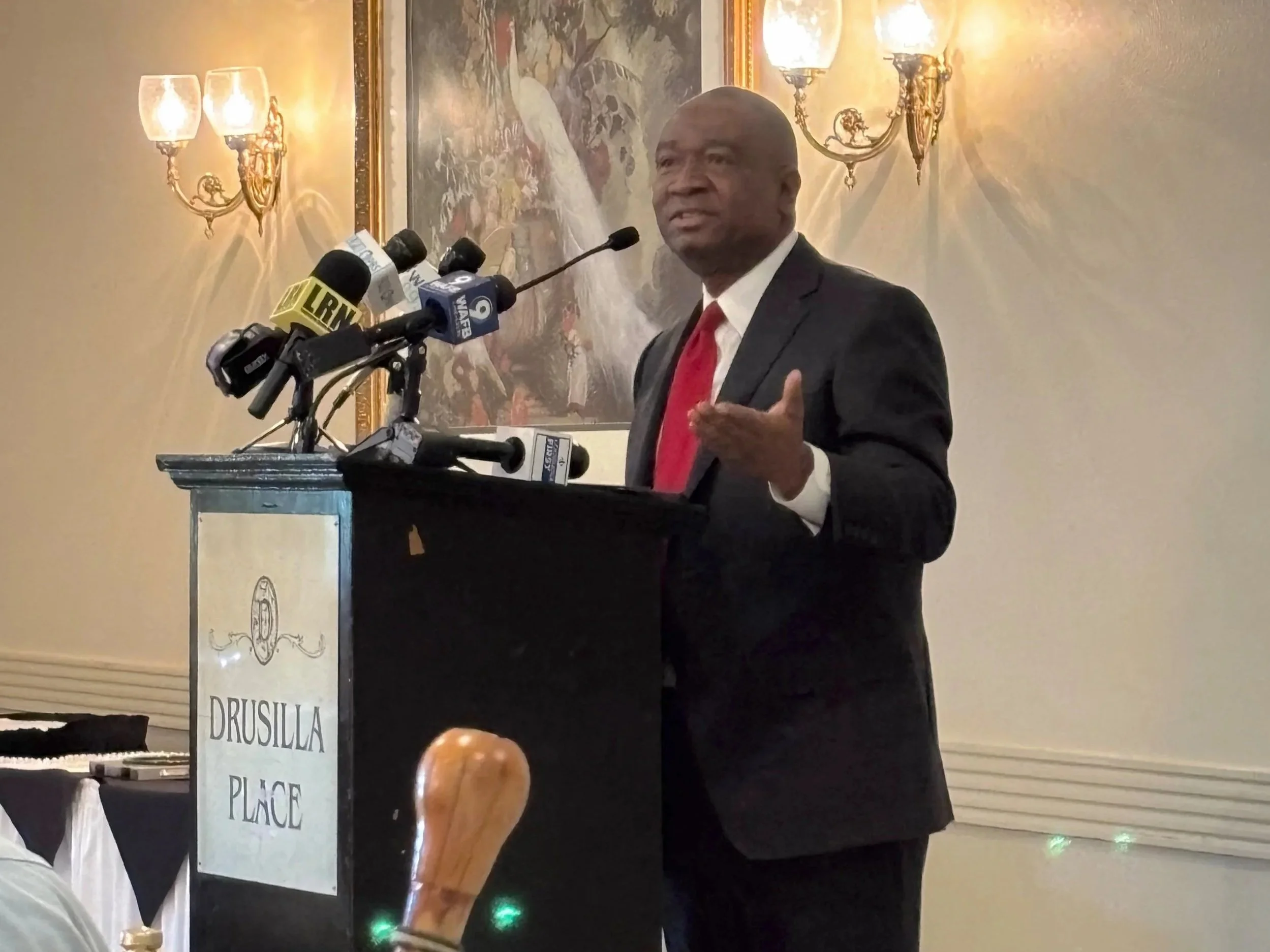
U.S. Rep Fields speaks at Baton Rouge Press Club Monday.
By Kylah Babin and Sheridan White
LSU Manship School News Service
BATON ROUGE – U.S. Rep. Cleo Fields (D-LA) told the Baton Rouge Press Club Monday (May 4) that Louisiana voters should vote as normal in elections for the U.S. House of Representatives even though Gov. Jeff Landry suspended voting in those races in the wake of a recent Supreme Court ruling that the state’s congressional districts were unconstitutional due to racial gerrymandering.
“At the end of the day, the Supreme Court did not say, ‘Halt the election,’ nor should it, and we're going to let the Supreme Court make a decision fairly soon about whether or not Louisiana can do what it did,” Fields said. “That's why I'm urging voters to actually go out and cast their votes for the whole ticket.”
U.S. Rep. Troy A. Carter, Sr. (D-LA) also released a statement Monday (May 4) encouraging voters to cast ballots in the races. Though the Callais ruling does not directly involve the second congressional district, which Carter represents, the Democrat from New Orleans has publicly opposed the governor's decision.
“Despite the suspension of the U.S. House elections, I am still encouraging voters to go to the polls and make their voices heard,” Carter said in a written statement. “We are hopeful that the courts will overturn this decision, and if they do, every vote cast will matter and must be counted. At the end of the day, participation is the foundation of our democracy. We should never discourage people from voting.”
Fields, a Baton Rouge Democrat, represents the sixth congressional district that was created by the Legislature in 2024 to give Louisiana a second majority-Black district. It was that district that drew most of the Supreme Court’s attention in its 6-3 vote on April 29 that ordered the state to once again redraw its congressional maps.
After Landry suspended the U.S. House primary elections based on the court’s ruling, Fields joined several other candidates in filing a federal lawsuit challenging the decision to suspend the congressional primary elections after voting had already begun. Election day is May 16, but absentee and early voting has already begun using the original ballot.
Fields and the other plaintiffs said suspending the elections mid-cycle violates the First, Fourteenth and Fifteenth Amendments, particularly after some voters had already begun casting ballots.
“The real question today for the court is, ‘Do we disenfranchise voters?’” Fields said. “This election had already started. People who wanted to be elected had already qualified. The Supreme Court ruled that that map that … this Legislature created and this governor signed was illegal, but the Supreme Court did not say, ‘Throw away those ballots.’ And, that's my fight today.”
Fields said he would explain his arguments in meetings this week with constituents in Shreveport, Alexandria, Lafayette and Baton Rouge.
When asked about his thoughts on what the Legislature would do with the maps next, he said he had not spoken with any of the state lawmakers or Landry on that issue. However, he was not shy of providing suggestions.
“I think the wisest thing for the Legislature to do is to do nothing until we get a final decision from the court,” Fields said regarding the case being sent back to a three-judge panel consisting of two federal district court judges and a judge from the 5th U.S. Circuit Court of Appeals. “When they redraw maps, they need to give people an opportunity to be heard. They need to do it like we’ve always done.”
At the same time, Fields urged the Legislature not to rush into approving a new congressional map, instead advocating for allowing the election process to proceed under the current circumstances.
This is not the first time Fields has faced redistricting consequences. He previously represented Louisiana in the House in 1993. He was forced to exit in 1997, a year before his term ended, after his district was redrawn into a northwest Louisiana-based seat that favored a Republican candidate.
Fields’ new congressional district was established only in 2024 after a prolonged redistricting battle aimed at addressing legal concerns over representation. Now, just a short time later, it appears to be on the chopping block as the implications of the latest Supreme Court ruling unfold.
Key questions remain unresolved, including what a new congressional map for Louisiana might look like. Fields noted uncertainty over whether Louisiana could end up with the six districts favoring Republicans by a margin of either 5-1 or 6-0.
“I'm not concerned about a single majority-Black district – I'm concerned about two,” Fields said. “If I was in the Legislature, I wouldn't vote for anything that wouldn't include two majority Black districts, out of defiance to this governor and this secretary of state. What is the rush? What harm is it to let people's voices be heard right now?”
While Fields’ district seems to be the most obvious one to be nixed, there could be another solution. Alternatively, the New Orleans-centered 1st District of U.S. Rep. Troy Carter could be the one under scrutiny. State Sen. Caleb Kleinpeter, R-Port Allen, has suggested that he would like to see Baton Rouge stay as a Black-majority district due to the population shift after Hurricane Katrina.
The situation in Louisiana comes as other Southern states are also taking action on redistricting. Tennessee and Alabama have both called special legislative sessions to redraw their congressional maps, highlighting the broader regional and national impact of recent legal challenges.
As legal and political tensions continue to rise, the future of Fields’ district and Louisiana’s broader congressional representation remains uncertain, with further court decisions and legislative actions likely to shape the path forward.
Tribune staff contributed to this report.